Quent — Remote Physiological Monitoring
Independent living, continuously cared for.
Quent is a non-invasive RPM ecosystem — a wrist wearable, a senior-first app, a clinician triage portal, and a quiet family view — designed so an 80-year-old can live alone, a nurse can watch 40 patients, and a daughter 2,000 miles away can breathe.
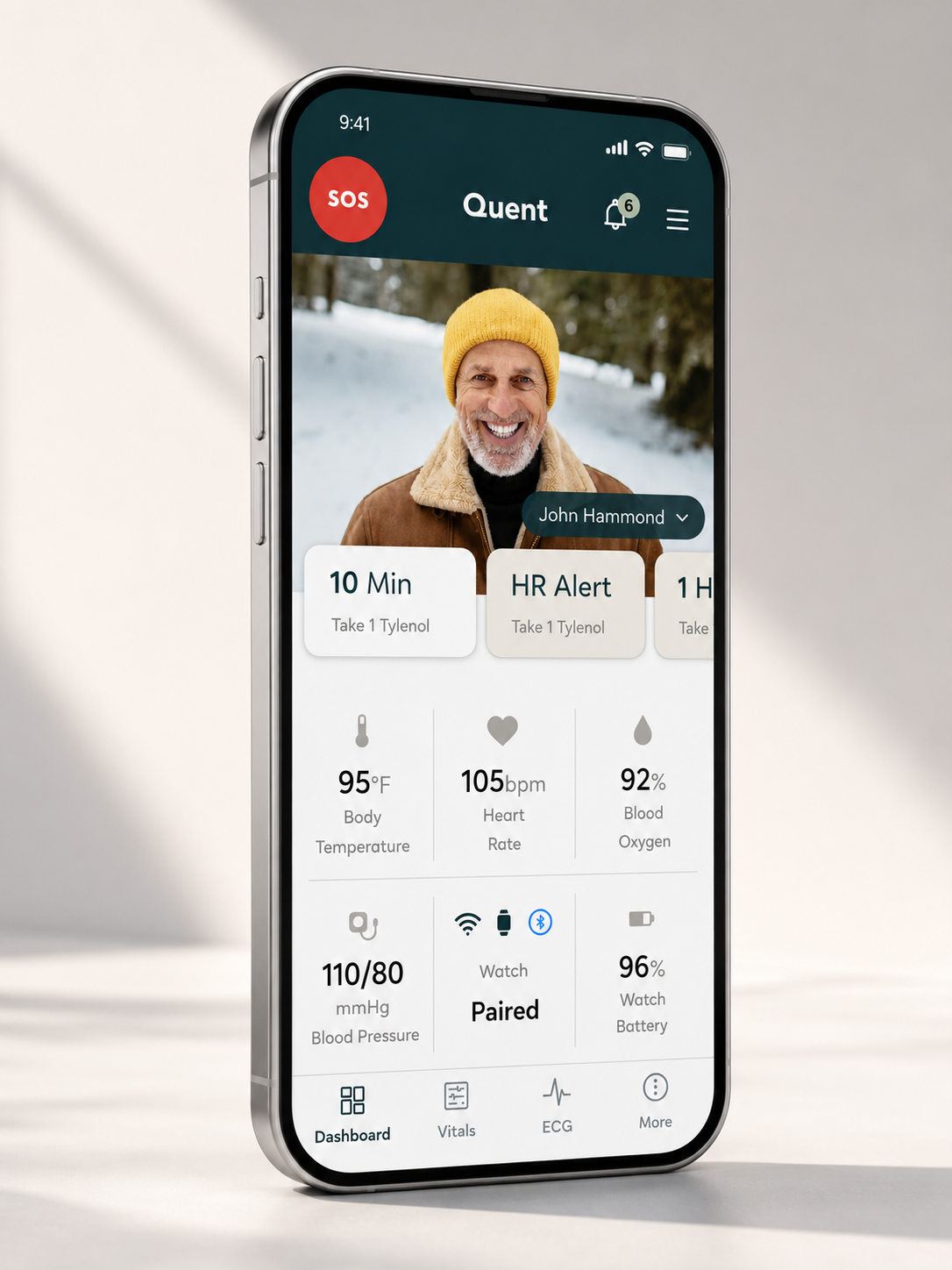
A thirty-week RPM ecosystem for people who don't think of themselves as patients.
Quent set out to meet a quiet, growing demand: aging adults who want to stay at home, providers who want to spot risk earlier, and families who want a calm signal between calls. Our job was to make all three feel like one product.
The brief: design a non-invasive wearable and app pair that an 80-year-old will actually wear, an overworked nurse will actually trust, and a faraway daughter will actually open.
My Role
Senior UX Designer
Research, IA, interaction, prototyping, accessibility, hand-off.
Duration
30 weeks
Mar – Jun 2023
Platform
Watch · iOS · Android · Web
Cross-audience ecosystem
Team
1 Sr. UX · 1 Visual · 2 iOS · 2 Android · 1 Embedded · 1 Backend · 1 PM · 1 Clinical Lead
Methods
Ethnography · Diary studies · Co-design with nurses · WCAG 2.1 AA audit · Wizard-of-Oz · Moderated usability
Tools
Figma · FigJam · Lookback · Maze · Principle · Notion
Care that only shows up at the appointment.
Hospitalisations among seniors are rising, but most are foreshadowed for days in data nobody is watching. We were asked to close that gap without turning the home into a clinic — or the patient into a dashboard.
Care that only happens at the clinic
Aging-related illness is continuous; appointments are not. Vitals trend silently between visits and become emergencies overnight.
Tech built for the able, not the aging
Existing wearables assumed perfect vision, dexterity and digital literacy. Setup alone disqualified most of the people who needed them most.
Families left in the dark
Adult children living away wanted a calm signal that mum was okay — not another login, another portal, another anxious phone call.
Three people, one signal.
Over four weeks I lived in the workflow — 14 in-home interviews with seniors, 6 full shifts shadowing nurses across two assisted-living facilities, and 8 calls with adult children. We audited four incumbent RPM products and coded six weeks of family text threads.
“I don't want to be a patient. I just want to know my heart is fine before I go for my walk.”
“I'm watching 38 residents. Tell me who needs me right now — quietly hide the other 37.”
“I want a green dot. Not a dashboard. Just — he's okay, you can breathe.”
Competitive landscape
| Player | Strength | Gap we exploit |
|---|---|---|
| Generic fitness wearables | Sensor accuracy | Wellness-led; no clinical loop, no SOS |
| Hospital-grade RPM | Clinical rigor | Industrial UI, multi-device setup, requires staff |
| Medical alert pendants | Single-button rescue | Reactive only — no vitals, no trends, no family |
| Quent | Senior-first wearable + provider + family | One pairing, three audiences, continuous care |
The RPM ecosystem we drew on the wall
Before a single screen, we mapped the loop: wearable captures vitals, app surfaces meaning, portal routes to the right clinician, family sees a calm status. Every feature later had to defend its place on this map.
Four tight loops, sixteen weeks.
We ran discovery, definition, design and validation as overlapping loops, not stages — so every clinical assumption got tested against a senior's hands within days.
Discover
Two weeks in two assisted living facilities. 14 senior interviews, 6 nurse shadows, 8 family video calls, audit of 4 incumbent RPM tools.
Define
Three jobs-to-be-done, three personas, one ecosystem map: watch → app → provider portal → family. Every screen mapped to a person's hardest moment.
Design
Lo-fi flows on paper with seniors, hi-fi in Figma. 18pt minimum body, 4.5:1 contrast floor, voice cues, single-tap primary action per screen.
Validate
Three rounds of moderated testing — seniors at home, nurses on shift, families on FaceTime. Wizard-of-Oz for the SOS flow before the radio was ready.
Accessibility as a baseline, not a pass
WCAG 2.1 AA was the floor: 18pt minimum body, 4.5:1 contrast, gesture alternatives, voice cues on every primary action.
Hiding numbers, on purpose
Clinicians and seniors saw different versions of the same vital. Plain language on the watch; raw data in the portal — a thresholds rulebook drawn up with the head nurse.
Wizard-of-Oz for SOS
We faked the radio before it shipped. A designer answered the test SOS button live so we could tune the latency budget before the engineering call.
One pairing. Three audiences. One quiet truth.
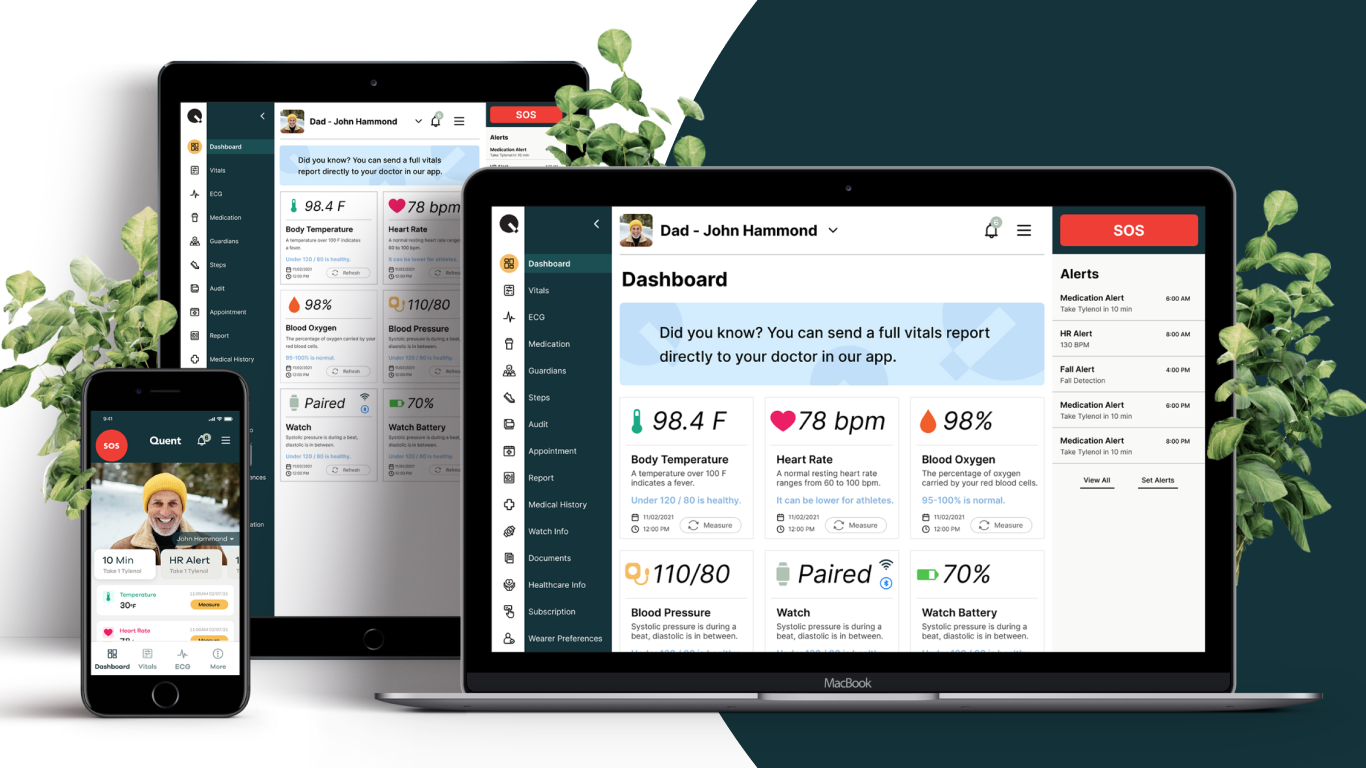
Quent ships as four surfaces around a single source of truth. Each surface answers exactly the question that audience asks first — and ruthlessly hides everything else.
A wrist that listens, quietly
- Continuous heart rate, BP, SpO₂, fall and activity — auto-synced.
- One physical SOS button — voice-confirmed before it pages a nurse.
- Single high-contrast face, large numerals, no nested menus.
A home screen that says 'you are okay'
- Today card: one sentence in plain language, then the numbers.
- Trends shown as shapes, not graphs — green hill, amber dip, red spike.
- Secure messaging and one-tap video with the assigned nurse.
Triage, not dashboards
- Patients sorted by clinical risk — not by name or room number.
- Threshold alerts grouped by acuity; quiet hours for stable patients.
- One click to write into the patient's chart and message the family.
A green dot is the whole UI
- Status pill: Calm · Watching · Needs you. Nothing more, by default.
- Optional weekly digest — heart, sleep, steps — written like a letter.
- Add siblings; everyone sees the same truth, no group-chat panic.
Adopted by the people we designed for.
Six months after launch, Quent had crossed twelve thousand active users — and, more quietly, had moved the metric that mattered: how independent its users felt.
“I forgot it was a medical device. That's the highest compliment I can give it.”
Robert · pilot user, 75
“I caught two AFib episodes in a week I would've missed entirely on paper.”
Nurse Emily · assisted living
“The green dot. That's what I open. That's all I need.”
Linda · daughter, family beta
What I would do differently
Design with hands, not eyes
The first prototype failed when an 80-year-old's tremor missed every target. We moved to wrist-rotation gestures and a single dome button.
Calm is a feature, not a finish
Hiding numbers is a clinical decision. We wrote a thresholds rulebook with the head nurse before we wrote a single screen.
Three audiences, one truth
If Robert, Emily and Linda see different statuses, the system has already failed. We treated parity as a release blocker.